
Cambodia Travel Guide: Angkor Wat, Phnom Penh And The South Coast
Angkor Wat Ticket Logistics
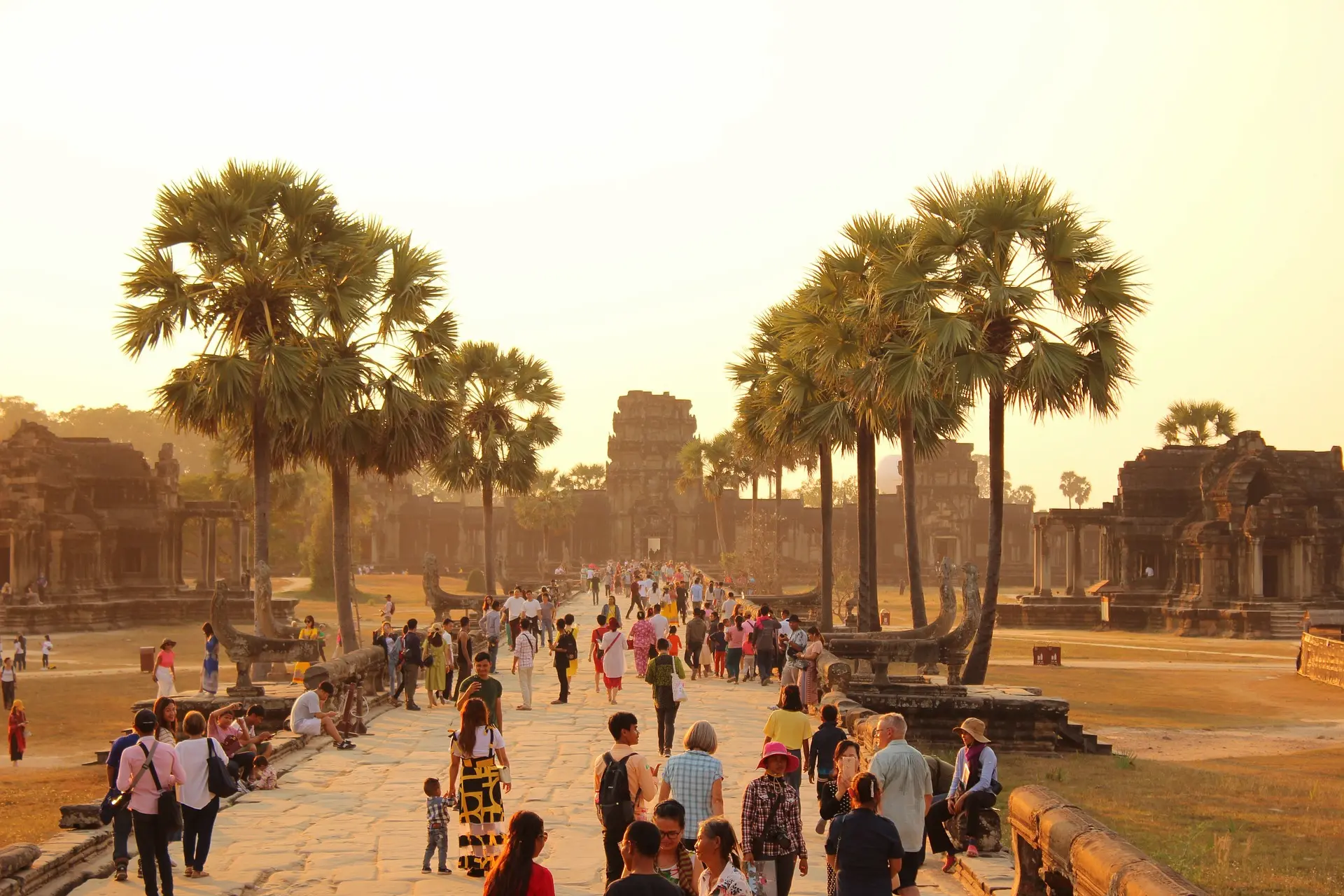
Angkor Enterprise, the government body that runs the Angkor Archaeological Park, sells three passes: $37 for one day, $62 for three days, and $72 for seven days. The 3-day pass covers any three days within a 10-day window, and the 7-day pass covers any seven days within 30, so you don’t need to visit on consecutive mornings. Children under 12 enter free with a passport as age proof, and there are no senior or disability discounts — the price is fixed everywhere it’s legally sold, whether that’s the ticket office on Road 60 in Siem Reap, the official app, or angkorenterprise.gov.kh.
Buy the wrong pass and you’ll either overpay or run out of time. Three separate 1-day tickets cost $111 combined, $49 more than the 3-day pass, so anyone visiting more than one day should skip the 1-day option entirely. The 1-day pass only makes sense if Angkor is a single stop on a tight regional itinerary — a layover day between Bangkok and Ho Chi Minh City, say — because one day covers Angkor Wat, Bayon and Ta Prohm at a sprint but leaves Banteay Srei and the outer temples untouched. If you’re staying in Siem Reap for four days or more, buy the 7-day pass: it’s only $10 above the 3-day price and removes any pressure to cram everything into 72 hours.
One detail that catches people out: buy your pass after 4:45 p.m. and you get free entry that same evening for sunset, on top of whatever day the printed ticket is dated for. Tickets are sold only through Angkor Enterprise. Tour agencies and hotels quoting a “convenience markup” on top of the official price aren’t offering a real service — they’re reselling the same ticket at 60% to 100% over face value.
Best Time To Enter
Angkor Wat at sunrise is the single most photographed moment in Cambodia, and it draws several thousand people to the same reflecting pool between 5:15 and 6:00 a.m. Gates open at 5 a.m., and if you want that shot without a stranger’s phone in the frame, arrive by 5:15 and walk past the crowd gathered at the main pool to the smaller pond on the northwest side of the moat. If the crowd itself is the problem rather than the light, flip the order: hit Bayon at sunrise instead — its 216 stone faces catch the first light beautifully and the tour buses haven’t arrived yet — then walk to Angkor Wat around 9 or 10 a.m., once the sunrise crowd has dispersed for breakfast.
Sunset gets a fraction of the sunrise traffic, and the free bonus-entry rule above makes it close to free if you’ve already bought tomorrow’s pass. Phnom Bakheng, the hilltop temple with a wraparound view of the jungle canopy, is Siem Reap’s classic sunset spot, though the site caps visitor numbers at 300 during peak months, so arrive by 4:30 p.m. in December and January. Midday, roughly 11 a.m. to 2 p.m., is the quietest stretch at every temple and the hottest, which is a fair trade if you’d rather have Ta Prohm’s tree roots to yourself than share them with a tour group.
Temples Beyond Angkor Wat Itself
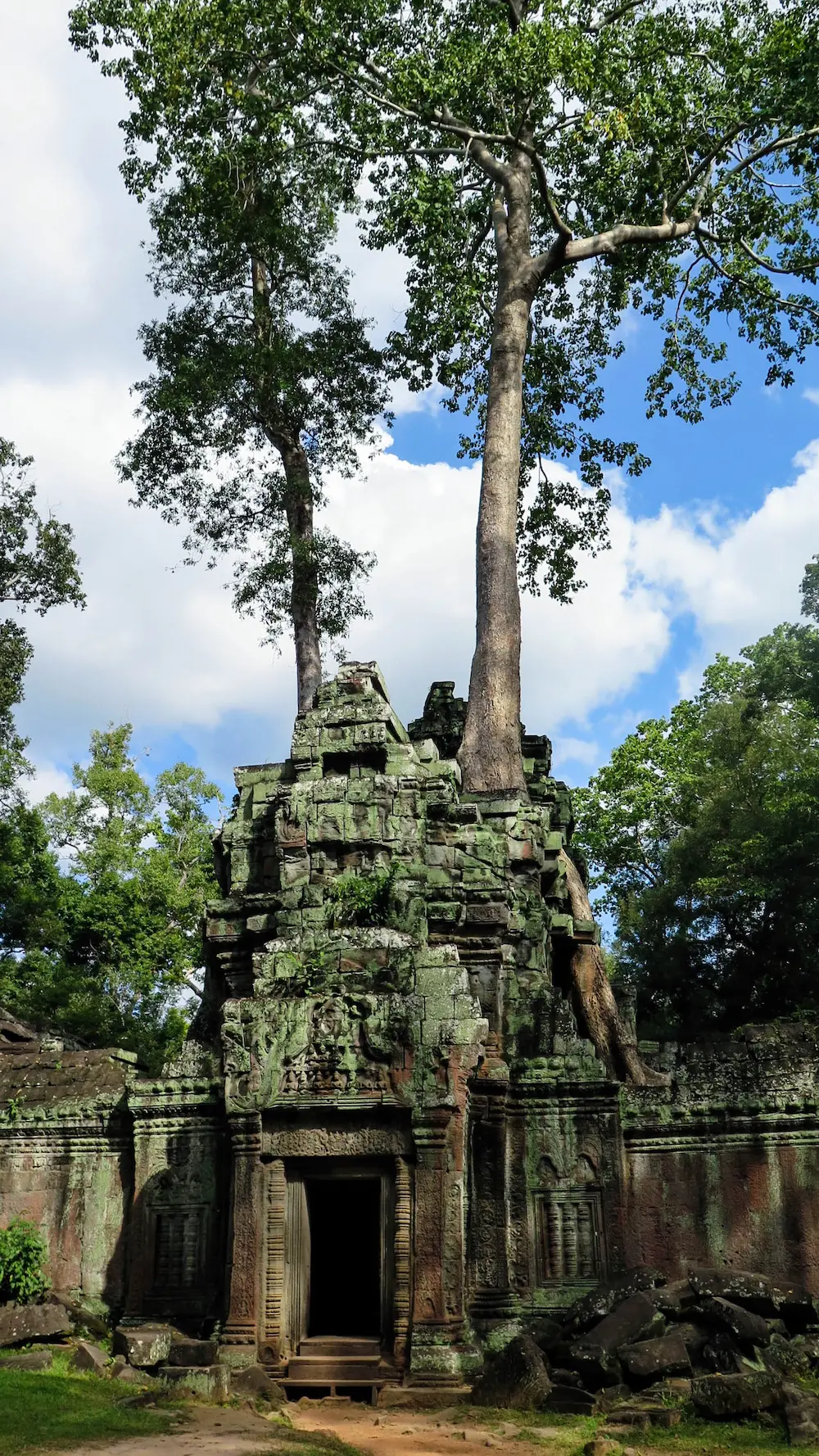
Ta Prohm is the temple where strangler fig roots have grown through and over the sandstone walls, left mostly unrestored to show what the jungle was doing to these sites before conservation work began. Go before 8 a.m. or after 3 p.m. — midday brings tour buses in numbers that make the narrow root-choked corridors genuinely hard to walk through. It’s roughly 15 minutes by tuk-tuk from Angkor Wat and worth the full hour it takes to actually look at the carvings rather than just photograph the roots.
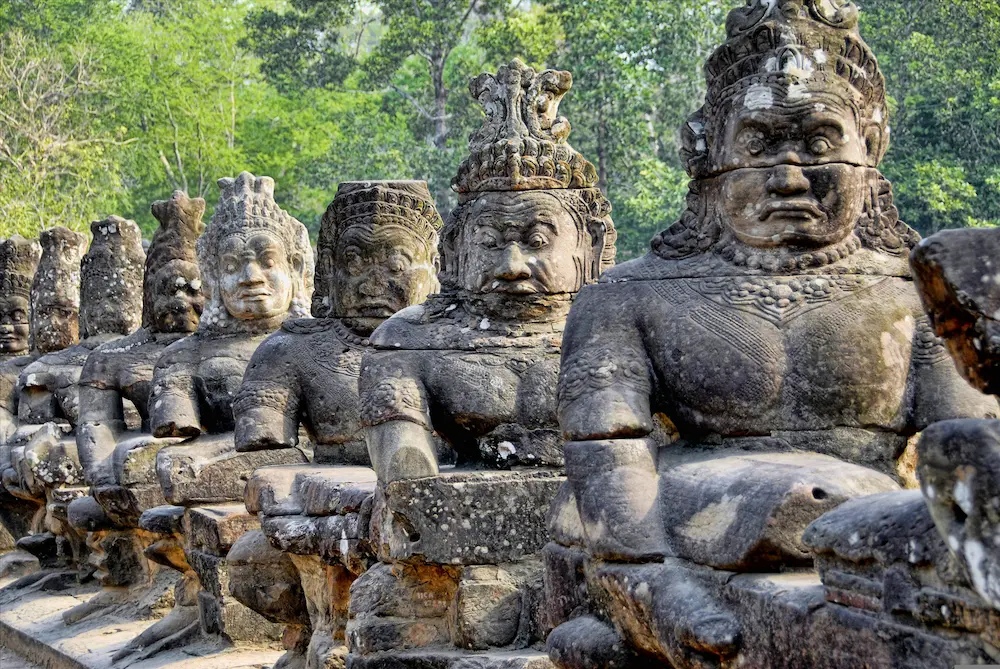
Bayon sits inside Angkor Thom, the walled royal city built after Angkor Wat, and its stacked towers carry 216 carved faces believed to depict the bodhisattva Avalokiteshvara with the features of King Jayavarman VII. It’s a smaller site than Angkor Wat and takes 45 minutes to an hour, which makes it easy to pair with a walk through the rest of Angkor Thom — the Terrace of the Elephants and the Terrace of the Leper King are both a five-minute walk away and included in the same pass.
Banteay Srei sits about 25 kilometers northeast of Angkor Wat, roughly 40 minutes by tuk-tuk, and it’s the one detour worth the extra fuel cost. Built from pink sandstone rather than the grey stone used elsewhere, it has the finest, deepest relief carving in the entire park — women who visit and know Khmer art history often rank it above Angkor Wat itself for craftsmanship. Late afternoon light turns the pink stone a genuine rose color, and because it’s a 40-minute drive from town, it never gets the crowd density of the temples inside the main circuit. If you have a 7-day pass, pair Banteay Srei with Beng Mealea, a jungle-swallowed temple 40 kilometers further out that’s covered by the same ticket and gives a sense of what Angkor looked like before restoration crews arrived.
Phnom Penh Beyond The Palace
The Royal Palace and Silver Pagoda are worth an hour, but Phnom Penh’s real weight is in its 20th-century history. Tuol Sleng, the former high school converted into the S-21 interrogation center under the Khmer Rouge, sits in a residential neighborhood a short tuk-tuk ride from the riverside and takes about 90 minutes to walk through with the audio guide. Choeung Ek, the killing field where most S-21 prisoners were taken, is 15 kilometers outside the city center — a round-trip tuk-tuk runs $10 to $15, and the $6 entry fee includes an audio guide built from survivor testimony. Go to both in the same morning rather than splitting them across two days; the sites are meant to be understood together.
For a different register entirely, Phsar Thmei — the Central Market — is a 1937 Art Deco building with a yellow dome that’s as much an architectural stop as a shopping one, while the Russian Market (Phsar Toul Tom Poung) a few kilometers south is where tailors and factory-overrun clothing outlets do business at prices well below what Siem Reap’s tourist shops charge. Frizz Restaurant runs a hands-on Cambodian cooking class near the riverside for around $30 that starts with a walk through a local market and ends with you cooking amok and lok lak yourself. In the evening, Sisowath Quay along the Tonle Sap riverfront fills with food stalls and outdoor bars as the sun drops, and a Mekong sunset cruise — most boats leave from the same stretch of riverfront for $5 to $10 per person — puts you on the water where the Tonle Sap and Mekong rivers meet.
Kampot And Kep On The Coast
Kampot is a slow river town of French colonial shophouses about three hours south of Phnom Penh, and it happens to sit next to some of the world’s best pepper-growing land. La Plantation, a working organic pepper farm about 25 minutes outside town, runs free self-guided tours through the vines and sells the peppercorns that end up on menus from Paris to Phnom Penh; Sothy’s Pepper Farm nearby does the same on a smaller, family-run scale. Both are worth combining with a Kampot River sunset cruise — small boats leave from the riverside in town for around $5 a head and drift past mangroves as the light goes orange over the Elephant Mountains.
Kep, 25 minutes further south, is built around one thing: crab. The Kep Crab Market is a row of stilted shacks over the water where vendors haul traps in every morning, and the crab shacks behind the market grill or stir-fry it with Kampot pepper for $5 to $8 a plate — order it “loub mrait,” pepper-fried, and you’re eating the dish Kep is actually known for. From the pier next to the crab market, boats run to Koh Tonsay (Rabbit Island) for about $7 to $10 round trip; it’s a 20-minute crossing to a slow, mostly undeveloped island with a couple of beach bungalow operations and almost no traffic beyond the occasional motorbike hauling supplies.
Koh Rong And The Southern Islands
Sihanoukville itself is a transit point, not a destination — most travelers pass through only long enough to catch a boat. From the Sihanoukville pier, Speed Ferry Cambodia and a handful of smaller operators run to Koh Rong in 45 minutes to just over an hour, with fares typically running $15 to $30 one-way depending on which pier you’re landing at and how far ahead you book.
Which beach depends on what you want. Koh Touch, where most ferries dock, is the party village — bars, hostels, and speaker systems running past midnight, packed along a short stretch of sand. Long Set Beach (also called Long Beach), a 20-minute walk or short moto-taxi ride around the island, is the opposite: seven kilometers of white sand with almost no development and a handful of bungalow resorts spaced far enough apart that you can walk for twenty minutes without passing another building. If Koh Rong itself sounds too built-up, Koh Rong Samloem, a separate island a bit further from Sihanoukville, is quieter across the board — Saracen Bay is the main beach there, with calmer water and a more scattered set of guesthouses, and ferries run from Sihanoukville on a similar schedule and price band as the Koh Rong routes.
Cambodia's Cost Advantage
Cambodia is still the cheapest of the mainland Southeast Asia trio, and the gap with Thailand has widened as Thai prices climbed through 2025. A backpacker daily budget in Cambodia — dorm bed, three meals, local transport, one paid activity — runs $25 to $35, against $30 to $50 in both Thailand and Vietnam. Siem Reap dorm beds at hostels like Mad Monkey or Onederz run $5 to $8 a night, compared with $11 to $21 in Bangkok’s Khao San Road area. A Khmer curry or amok at a sit-down restaurant costs $4 to $7, roughly what you’d pay for Bangkok street-stall pad kra pao once you add a drink, though Vietnam’s pho and banh mi at $1 to $3 still undercut both.
The one place Cambodia loses that advantage outright is temple admission. Vietnam’s museum and pagoda entries run $1 to $3, and Thailand’s major temples are usually under $10 — Angkor Wat’s $37 base ticket is the most expensive single attraction fee in mainland Southeast Asia by a wide margin. Spread across a 3-day pass, though, that works out to roughly $20 a day, which still lands below what a half-day guided tour costs in Chiang Mai or Hoi An. Everything else — tuk-tuks, beer, hostel beds, street food — keeps Cambodia at or below Vietnam’s price floor and comfortably under Thailand’s.
The E-Visa Process
The Cambodian tourist e-visa costs $36 total — a $30 visa fee plus a $6 processing charge — and it’s issued exclusively through evisa.gov.kh, a Ministry of Foreign Affairs site with a .gov.kh domain. Processing officially takes three business days, though some applicants report approval within 24 hours outside peak season; apply at least a week before departure to leave room for a correction if you make one. The application itself takes about 15 minutes: passport bio-page scan, a passport-style photo, your Cambodia accommodation address, and a card payment.
The e-visa is valid for 90 days from the date it’s issued, meaning you have a three-month window to actually enter the country, and once you cross the border it allows a single 30-day stay. It can be extended once, for roughly $45, through an immigration office in Phnom Penh or via the same evisa.gov.kh portal, bringing a maximum stay to 60 days. Third-party visa sites are the most common Cambodia-related scam travelers run into before they’ve even left home — sites with names like “cambodia-evisa-online” or similar variations buy search ads above the official result and charge $50 to $100 for the identical visa. If the site isn’t evisa.gov.kh, close the tab.
Best Time To Visit
Cambodia’s dry season runs November through March, and it’s the easiest window for temple-hopping — daytime highs sit in the 82–90°F (28–32°C) range with low humidity, and December and January are peak season at Angkor, meaning higher hotel prices and thicker crowds at sunrise. April and May are the hot season, with Siem Reap regularly hitting 100–104°F (38–40°C) in the early afternoon; walking between temples during these months means starting at dawn and retreating indoors by 10 a.m.
June through October is the rainy, or “green,” season, and it’s underrated for a country this hot. Rain typically falls in short, heavy afternoon bursts rather than all day, mornings stay clear for temple visits, and the moat around Angkor Wat is full of water for the postcard reflection shot that’s often a dry, cracked mudflat by March. Siem Reap hotels frequently drop rates by 30% to 50% in this window, and the south coast sees far fewer boats to Koh Rong, which means quieter beaches if you don’t mind a shower rolling through most afternoons.
A Realistic 10-Day Itinerary
Days 1–3, Siem Reap: land, settle in, and use a 3-day Angkor pass across two full temple days rather than three rushed ones. Day one covers the small circuit — Angkor Wat, Bayon, Ta Prohm — with an early sunrise start; day two is Banteay Srei and Beng Mealea for the carving detail and the untouched-jungle version of Angkor. Keep a spare day in the pass for a floating village trip on Tonle Sap lake or simply a slower second pass through Angkor Wat itself.
Day 4, travel day: bus to Phnom Penh with Giant Ibis or Mekong Express, roughly six hours and $17 to $35 depending on seat class, or a 45-minute domestic flight if the road time doesn’t appeal. Days 5–6, Phnom Penh: Tuol Sleng and Choeung Ek in one morning, Royal Palace and Central Market the next day, riverside food stalls and a Mekong sunset cruise to close out the evenings.
Day 7, travel to Kampot: roughly three hours by bus, arriving in time for a river sunset cruise the same evening. Day 8, Kep: a half-day trip from Kampot for crab at the Kep Crab Market and a boat out to Koh Tonsay if the weather holds. Days 9–10, Sihanoukville and Koh Rong: bus to Sihanoukville, ferry across to Long Set Beach for a genuine last-days-of-the-trip stretch of sand, and either fly out of Sihanoukville International Airport or bus back to Phnom Penh for an international departure.
Anyone with two weeks or more should break off the standard loop and add Battambang and Kratie: Cambodia’s Backroads, our spoke guide to the bamboo train, the circus school, and the Irrawaddy dolphin pools on the Mekong that this itinerary skips entirely.
Getting Around And Crossing Borders
Inside cities, tuk-tuks are the default and fares are negotiated up front — a short hop in Siem Reap or Phnom Penh runs $2 to $4, and a full-day driver covering the Angkor small circuit costs $15 to $20. Giant Ibis, Mekong Express, and Virak Buntham run the main intercity bus routes; Giant Ibis in particular runs premium coaches between Phnom Penh, Siem Reap, Sihanoukville, Kampot, Kep, and Battambang, and booking a day ahead online avoids sold-out departures in peak season.
Crossing into Vietnam is straightforward: Giant Ibis and Mekong Express both run direct buses from Phnom Penh to Ho Chi Minh City through the Bavet–Moc Bai border post, a 6-to-7-hour trip including the crossing for $16 to $25, though you’ll need a separate Vietnam e-visa arranged in advance through the Vietnamese immigration portal.
Crossing into Thailand is a different situation as of 2026. Armed conflict along the Cambodia–Thailand border has closed all land crossings, and the U.S. State Department and other Western governments advise against any travel within 50 kilometers of the border zone, including the Poipet crossing that used to connect Siem Reap and Bangkok overland. Siem Reap itself sits roughly 140 kilometers from the nearest affected area and continues receiving flights normally, but anyone routing between Cambodia and Thailand should fly rather than plan an overland Poipet crossing until the border situation changes — check the latest embassy notices before booking anything overland near that frontier.
Scams Worth Knowing
The most common Angkor-specific scam is a tuk-tuk driver or tout claiming the official ticket counter is “closed for lunch” or “sold out,” then steering you to a private seller charging double. The Angkor Enterprise counter on Road 60 doesn’t close for lunch, and tickets never sell out — walk past anyone making that claim. In Phnom Penh, a near-identical version happens near the Royal Palace, where someone tells you the palace is “closed today for a ceremony” and offers to guide you to a gem shop or silk factory instead; the palace’s actual opening hours are posted at the gate.
Fake e-visa websites remain the scam most travelers hit before they even land, charging $50 to $100 through ads that outrank the real evisa.gov.kh listing. On the ground, watch small-bill change: Cambodia runs on a dual-currency system where USD covers larger amounts and riel covers change under a dollar, at a rate of roughly 4,000 riel to $1, and it’s easy to get shorted if you’re not doing the math. At land border crossings, touts sometimes demand a “visa processing fee” that doesn’t exist for anyone holding a pre-approved e-visa — the only payment due at the border is nothing, since you’ve already paid online.